How Diamonds Are Graded: The 4Cs, the Labs, and the Report
If diamond grading has left you feeling lost in letters and numbers, that’s normal. At the heart of it are the 4Cs: cut, color, clarity and carat weight. Cut shapes how much a diamond sparkles, so it’s the grade to be careful with. Color and clarity usually have more give. You’ll see all four written down in a grading report from an independent lab. By the end, you’ll know what each grade means, how it looks in a real stone, how to read a report and where to be flexible.
Who Grades a Diamond
The grades you see on a diamond report come from a gem lab such as GIA or IGI, not from the person selling you the stone. What you’re reading is a trained judgment made under set conditions. At GIA, for example, graders compare color against master stones, diamonds of known grade, and judge clarity at 10x magnification. More than one grader looks at each stone. The differences are subtle. GIA says color in the G to J range is “often unnoticeable except by trained graders.” That’s why a grade or two often won’t show in the stone you’re looking at. The report names its lab, so make sure it’s one you recognize. Then judge the stone itself, in photos, video or in person.
Cut
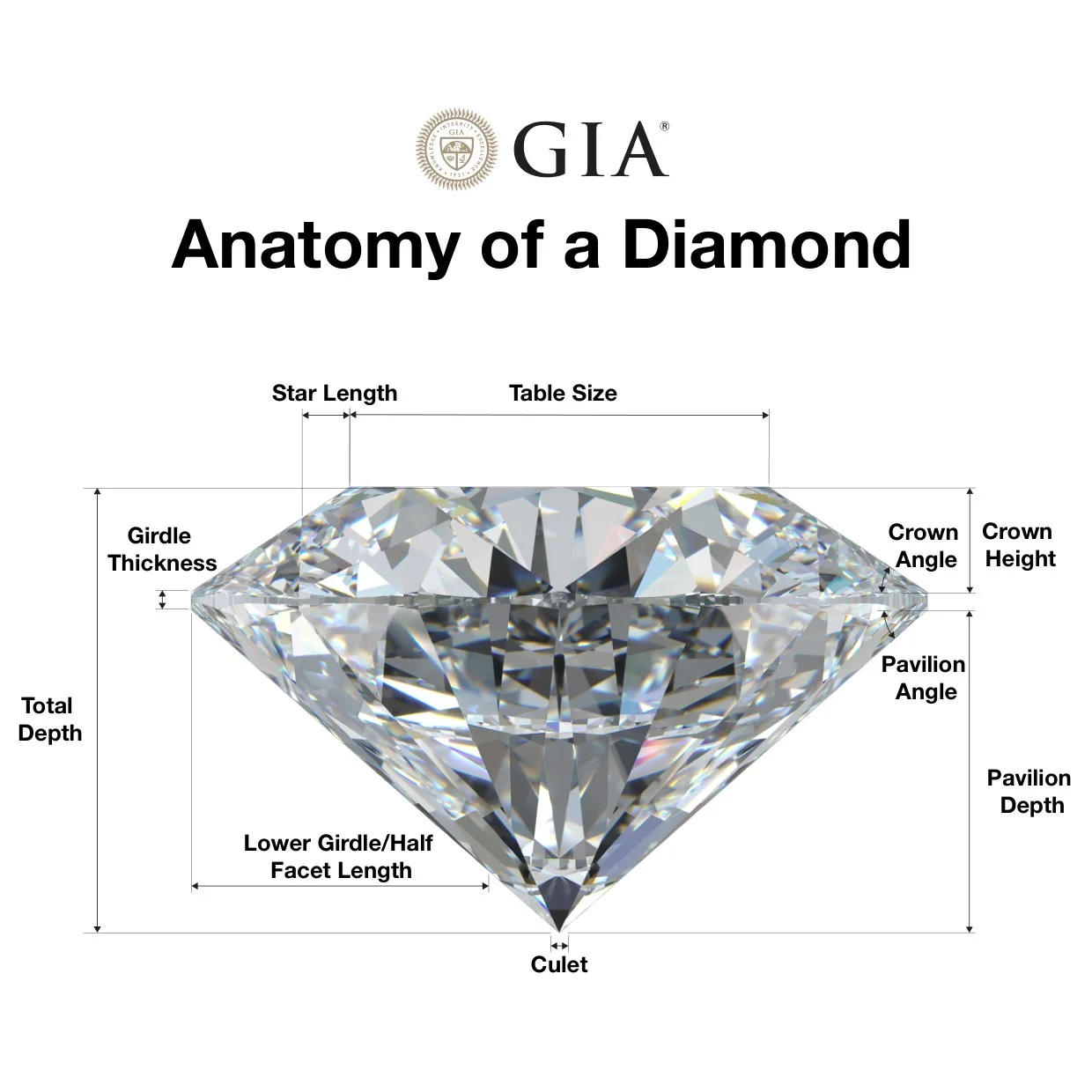
Cut decides how much a diamond sparkles. Color and clarity describe the material; cut describes how well it was shaped to handle light.
A well-cut stone takes light in through the top, bounces it off the facets underneath and sends it back to your eye as brightness and flashes of color. Cut too shallow, light leaks out the bottom. Too deep, it escapes out the sides. Either way the stone looks darker, however good its color and clarity.
How cut is graded
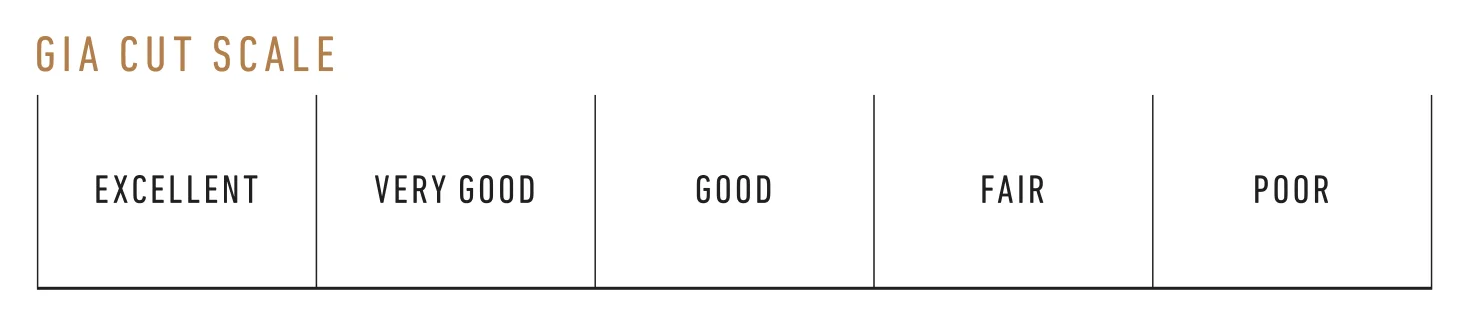
GIA grades the cut of round brilliants from Excellent down to Poor, and IGI grades rounds too (and fancy shapes, for lab-grown). Both also grade polish and symmetry; Excellent in all three is called “triple Excellent” or “3X”. For a round, aim for the best cut grade.
The American Gem Society’s well-respected cut standard runs from 0 (best) to 10. AGS closed its own lab in 2022, but GIA now offers an AGS Ideal report, an add-on that grades light performance on that scale.
Fancy shapes (oval, cushion, emerald, pear and others) get no overall cut grade from GIA, so you judge them by eye:
- Length-to-width ratio sets the outline, such as how elongated an oval looks. It’s a matter of taste.
- Bow-tie: many oval, pear and marquise cuts show a dark band across the middle. Ideally you want it as faint as possible.
- Photos or video tell you more than the numbers do.
Color
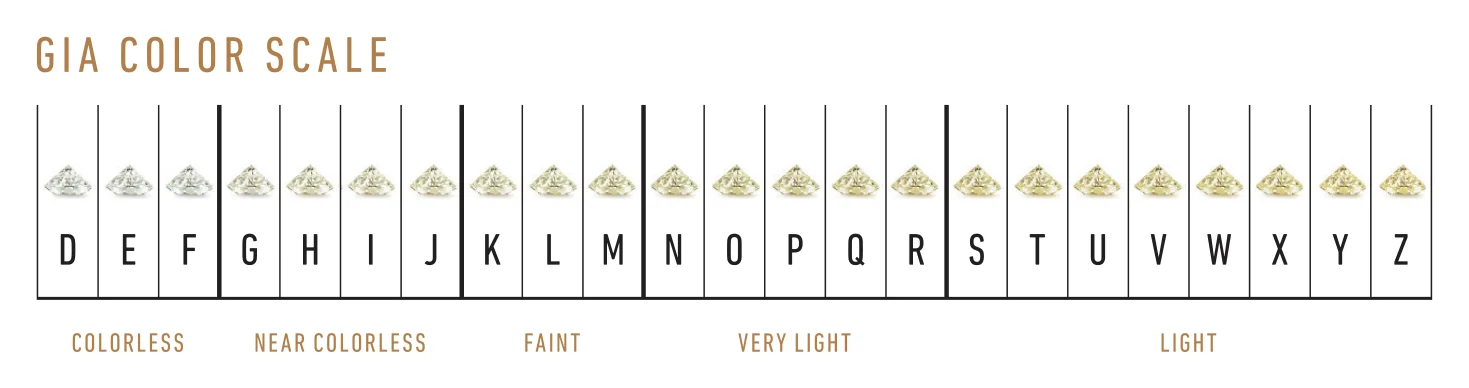
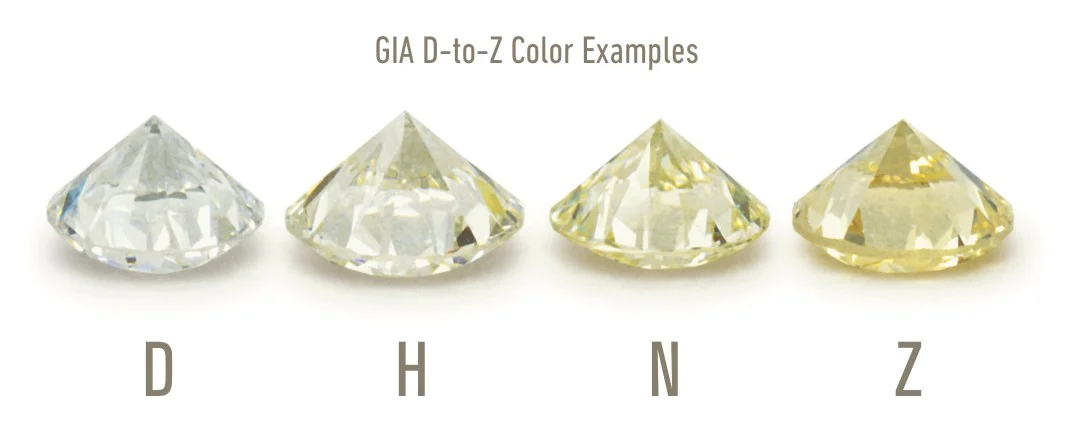
Color grades measure how little color a diamond has, from D (colorless) to Z (light yellow or brown). Neighboring grades are very hard to tell apart once a stone is set.
Two things change how color looks:
- Metal: white metals make a warm tint show; in yellow or rose gold it’s not usually as noticeable.
- Shape: rounds and radiants hide color best. Emerald and Asscher cuts show it most, so go a grade higher for those.
Clarity
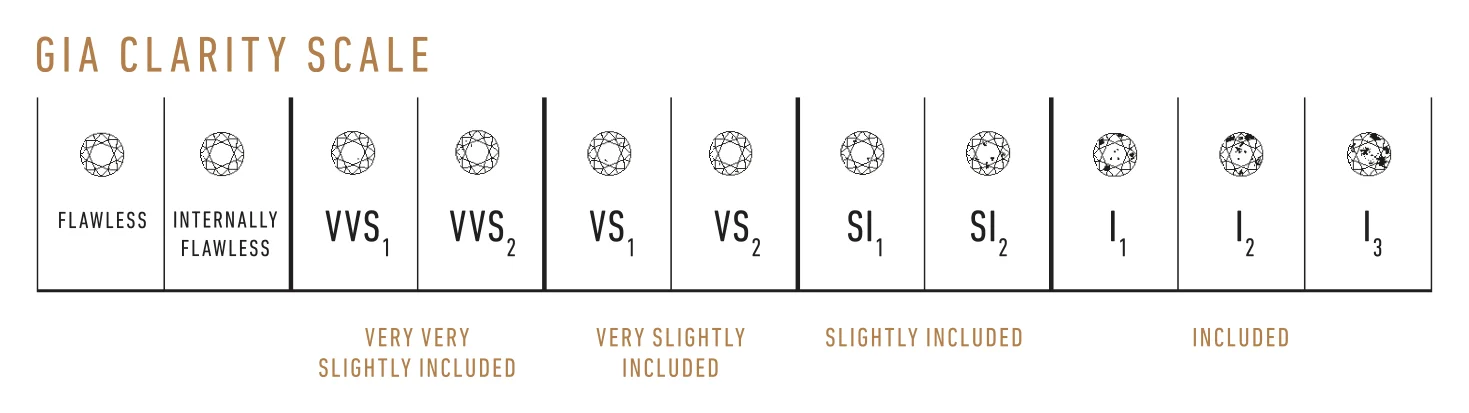
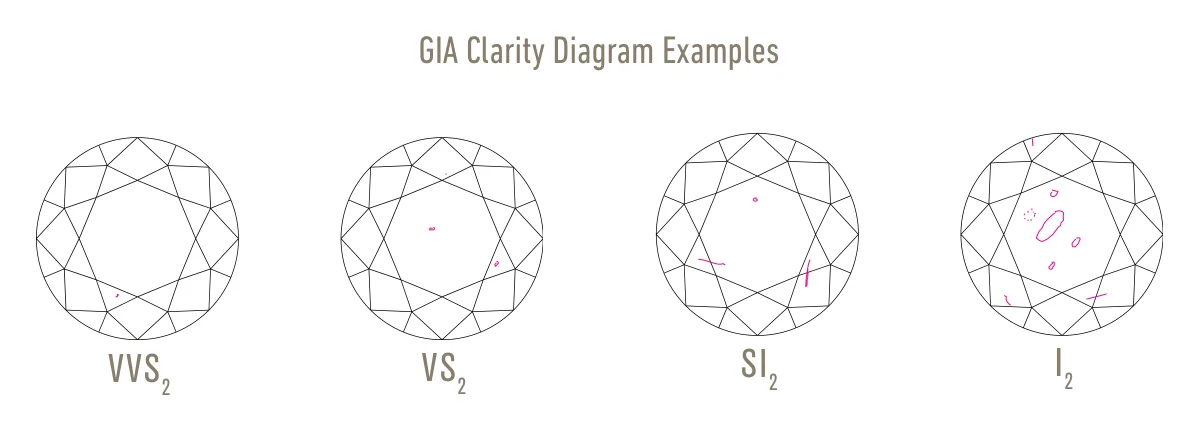
Most diamonds have tiny natural features: inclusions inside the stone and blemishes on the surface. Clarity grades how easily a grader finds them at 10x magnification, not by eye.
The eye-clean sweet spot
Eye-clean means you can’t see any inclusions face-up without magnification. It isn’t on the report; it’s a judgment about one stone. Most VS2 rounds are eye-clean, and many SI1s are too, but check each SI1, especially a large one. Either way they cost much less than VVS stones that look the same in a ring.
What the inclusion is and where it sits matter more than the letter:
- A small white crystal near the edge, where a prong can cover it, is harmless.
- A dark crystal under the table (the big top facet) is the one you’ll notice.
- A feather (a small fracture) reaching the surface near the girdle, the outer edge, can be a durability risk.
- Emerald and Asscher cuts show inclusions through their large, open facets, so aim for VS2 or better, higher in stones over 2 carats.
Carat
Carat is weight, not size: one carat is 0.2 grams. A stone cut too deep carries weight underneath, so it looks smaller from the top than its carat weight suggests.
Buying just under a magic weight
Prices jump at popular weights like 0.50, 1.00, 1.50 and 2.00 carats. A well-cut 0.90-carat round is only about 0.2 mm narrower than a 1.00-carat, which almost nobody can see, but with the same grades it can cost noticeably less.
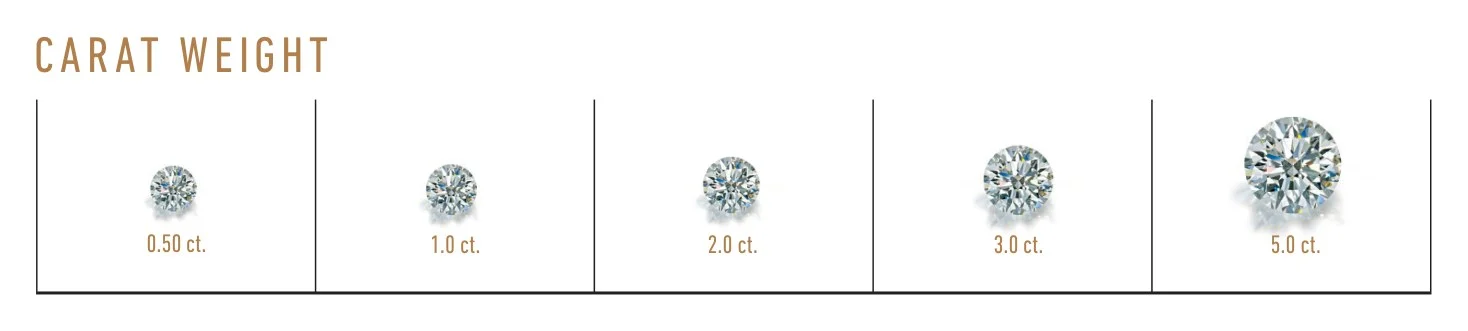
The same works at every step: 0.45 instead of 0.50, 1.40 instead of 1.50. The trade-off is not being able to say “a full carat”.
Fluorescence
Some diamonds glow, usually blue, under ultraviolet light. Reports describe it from None to Very Strong. Under normal indoor light you usually won’t see it.
Its bad reputation is mostly undeserved. In a 1997 GIA study, average viewers saw no consistent effect, and strongly blue stones often looked better face-up. A 2021 GIA study traced the rare hazy look mainly to structural defects in the stone, not to fluorescence.
- None to Medium: not a concern.
- Strong or Very Strong: the trade has long seen strong blue as a negative, so these can be priced lower. Check a photo or video first.
Natural vs. Lab-Grown
A lab-grown diamond is a diamond, with essentially the same chemical, physical and optical properties as a mined one, but grown in a laboratory. U.S. guidance says it must be clearly described as lab-grown, for example “laboratory-grown” or “laboratory-created”. The grading differs:
- IGI grades lab-grown diamonds on the same color and clarity scales it uses for natural stones.
- GIA, for lab-grown diamonds submitted since October 1, 2025, no longer gives color and clarity grades. It classes them as Premium or Standard, or gives no assessment, saying more than 95% fall in a very narrow range of color and clarity. Older GIA lab-grown reports with letter grades remain valid.
- GIA also laser-inscribes “Laboratory-Grown” on the girdle.
With lab-grown, high color and clarity are easy to find, so focus on cut and how the stone looks. With natural diamonds a grade step can change the price noticeably, so the trade-offs below matter more.
You can browse both on our website: search natural diamonds or search lab-grown diamonds.
The Grading Report
All the grades above end up on one page: the grading report. It’s the lab’s description of the stone, not an appraisal, so it doesn’t state a value. You’ll often hear it called a “certificate”, but GIA’s terms say its reports may not be called a certification, guarantee or appraisal.
What each numbered part of the sample shows (all values are invented):
- Report number, date and origin. Report SR-000427, dated October 13, 2026. Check the title first: GIA’s Natural Diamond Grading Report is for natural diamonds only, and IGI’s natural reports say “Natural Diamond” under Description. Lab-grown stones get a separately titled report. Enter the number on the lab’s website (GIA Report Check or IGI’s report verification) to confirm the report matches the stone.
- Shape and measurements. Round brilliant, 6.43–6.47 × 3.95 mm: the smallest and largest diameter, then the depth. Measurements show how big the stone looks; carat weight doesn’t.
- The 4Cs. Carat weight, color, clarity and cut grade. Each has its own section above. An asterisk next to a color grade means the lab detected a color treatment.
- Finish, fluorescence and inscription. Polish and symmetry grades, the fluorescence description, and the inscription: the report number laser-written on the girdle.
- Comments. What the plot can’t show, such as “Additional pinpoints are not shown.” Any treatment the lab detects, such as laser drilling, is listed here. “Clouds are not shown” on an SI stone is worth a photo or video, since heavy clouds can dull brightness. IGI lab-grown reports usually give the growth method (CVD or HPHT) and any post-growth color treatment.
- Proportions diagram. The stone’s angles and percentages. On a round graded Excellent for cut, the lab has already checked these.
- Clarity plot. Where each feature sits, seen from the top (crown) and bottom (pavilion). A mark under the table matters more than one near the edge. GIA’s Diamond Dossier, a shorter report common for stones under 2 carats, has no plot.
- Key to symbols. Inclusions inside the stone in red; blemishes on the surface in green or black.
- Grading scales. The lab’s color and clarity scales, for reference.
Where to Be Flexible
Most of this applies to any diamond you choose on its own grades, from an engagement ring’s center stone to a pendant or a pair of studs. This applies to both natural and lab-grown diamonds, but the price differences are much more noticeable with natural. Lab-grown diamonds are so competitive that while you may still see some savings, they will be minimal.
Hold firm on:
- Cut: for a round, the top grade (Excellent, or Ideal on IGI lab-grown reports), with Very Good or better polish and symmetry.
- Durability: the main risk is a large feather that reaches the surface. Pointed shapes like pear, marquise, and princess cuts also need prongs that protect the points.
Be flexible on:
- Color: a grade or two lower usually looks the same, and warmth is less noticeable in yellow or rose gold.
- Clarity: most VS2 rounds are eye-clean; check each SI1 on its own.
- Fluorescence: Strong or Very Strong is often fine; check a photo or video first.
Emerald and Asscher cuts: go a grade higher on color, and stick to VS2 or better on clarity.
Whatever you’re buying, judge the actual stone, not only the report: look at photos and video, or see it in person.
Quick Answers
Who grades a diamond?
An independent gem lab such as GIA or IGI. At GIA, several graders assess each stone anonymously, compare its color against master stones, and check clarity at 10x magnification.
Which of the 4Cs matters most?
Cut decides how much a diamond sparkles, so for a round, take the top grade: Excellent, or Ideal on IGI’s lab-grown reports. Ovals, pears and other fancy shapes get no GIA cut grade. Judge them on photos and video, and look for as faint a bow-tie as possible.
What color grade do I need so it doesn’t look yellow?
Color runs from D (colorless) to Z, and neighboring grades are hard to tell apart once a diamond is set. G–H is a safe place to save in white gold or platinum, and I–J in yellow or rose gold, where warmth shows less. Emerald and Asscher cuts show color most; rounds hide it best.
Do I need VVS clarity, or will VS2 or SI1 look the same?
Clarity runs from Flawless (FL) down to Included (I3) and is graded at 10x magnification, so a lower grade can still look clean to your eye. Most VS2 round diamonds look clean without magnification. Many SI1 rounds do too, but not all, so check each SI1 stone individually, especially larger ones. Emerald and Asscher cuts show inclusions more easily, so choose VS2 or better for those shapes.
Is a 0.90 carat diamond noticeably smaller than a 1 carat?
No. Carat measures weight (1 carat = 0.2 grams), not size. A well-cut 0.90 ct round is only about 0.2 mm narrower than a 1.00 ct, yet prices jump at 0.50, 1.00, 1.50 and 2.00 ct.
Should I avoid a diamond with fluorescence?
Not by default. Fluorescence is a glow, most often blue, that some diamonds give off under UV light. In GIA’s 1997 study, average viewers saw no consistent effect, and strongly blue stones were generally seen as having better (whiter) color face-up. Haze is rare, and strong blue can be priced lower, so they can be a place to save if the photos look clear.
Are lab-grown diamonds graded the same way?
A lab-grown diamond has essentially the same properties as a mined one and must be described as lab-grown. IGI grades lab-grown stones on the same letter scales. Since October 1, 2025, GIA classes them Premium or Standard instead, so an IGI grade like “F VS1” can’t be matched one-to-one with a GIA “Standard.”
Is a diamond certificate the same as an appraisal?
No. A grading report, often called a certificate, is an independent lab’s description of the stone, and it states no value.
Where can I be flexible without it showing?
Keep cut at the top grade, then be flexible where the eye can’t tell:
- Color: G–H in white metal, I–J in yellow or rose gold.
- Clarity: VS2, or an SI1 you’ve checked.
- Carat: just under a major weight (0.50, 1.00, 1.50 or 2.00 ct). A 0.90 instead of a 1.00, or a 1.40 instead of a 1.50, looks almost the same and can cost noticeably less.
- Fluorescence: strong blue can be priced lower; check that the stone looks clear.
Where an inclusion sits matters more than its grade, so judge the actual stone from photos and video, or see it in person.